Liar Game
Synopsis — from MyAnimeList
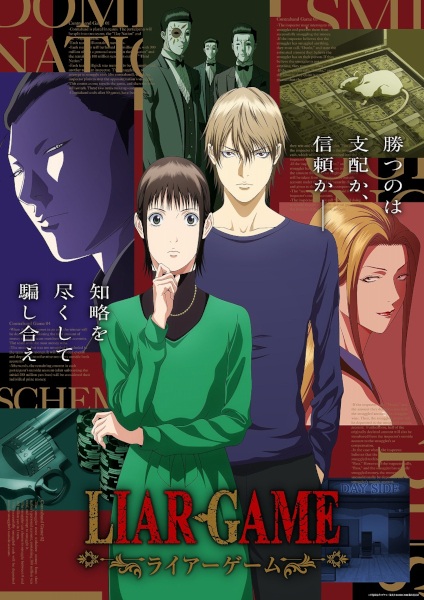
Nao Kanzaki is honest to a fault. Uncorrupted and virtuous, Nao is the perfect target for a large-scale scheme—the so-called Liar Game. Suddenly in possession of one hundred million yen, she is expected to steal the same amount from her assigned opponent—her former middle school teacher—or face crushing debt. Trusting her teacher without question, Nao quickly realizes that she is trapped. To gain an advantage, Nao comes in contact with Shinichi Akiyama, a brilliant con artist just released from prison. Though Akiyama has no real reason to help the naive girl, he ends up aiding her victory. However, driven by her unwavering sense of justice, Nao chooses to continue into the next round, and Akiyama, unwilling to leave her to fail, joins her. In the Liar Game, participants are expected and required to deceive, manipulate, and betray or be buried in lifelong debt. Yet Nao, with the help of Akiyama's genius, is determined to beat the game without abandoning her morals and prove that generosity and sincerity will always prevail.
Audience Consensus
Audience opinion on Liar Game is highly divided, primarily due to the protagonist's perceived intelligence and the predictability of the games. While some praise the intricate game theory, psychological depth, and faithful adaptation, a significant portion finds the protagonist insufferable and the plot overly simplistic. This polarization suggests a core disagreement on the show's fundamental strengths and weaknesses.
Strengths
- Mastery of game theory and escalating game mechanics.
- The games are logically sound, allowing viewers to deduce strategies.
- The psychological depth and outsmarting the system are praised.
- Faithful adaptation of the manga that defined the genre.
- Compelling characters and engaging story (for some).
- The premise and theme are interesting.
- Opening is amazing.
Weaknesses
- Protagonist (Nao) is perceived as too stupid, gullible, and annoying, leading to repetitive behaviors and lack of growth.
- The plot twists are often obvious and predictable.
- Animation quality is criticized as mediocre, a slideshow, or low-effort.
- Character designs are bland or inferior to the manga.
- Pacing can be too fast, causing viewers to get lost.
- Villains are portrayed as comically evil.
- The show is considered a rage-bait anime by some.
- The anime skips important details from the manga, weakening Nao's characterization and empathy.
- The dynamic between Nao and Akiyama is not well-developed.
- Art style is considered bland and lacking unique aesthetic.