Princess Mononoke
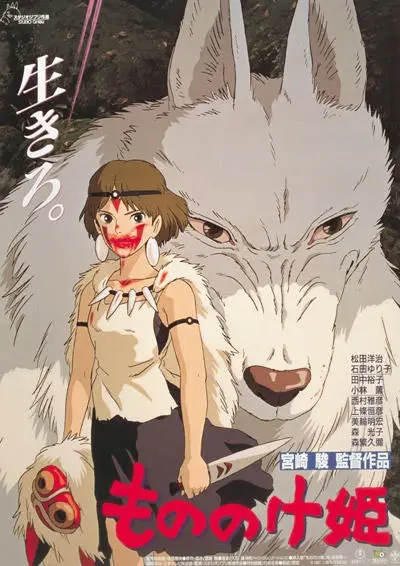
Synopsis — from MyAnimeList
When an Emishi village is attacked by a fierce demon boar, the young prince Ashitaka puts his life at stake to defend his tribe. With its dying breath, the beast curses the prince's arm, granting him demonic powers while gradually siphoning his life away. Instructed by the village elders to travel westward for a cure, Ashitaka arrives at Tatara, the Iron Town, where he finds himself embroiled in a fierce conflict: Lady Eboshi of Tatara, promoting constant deforestation, stands against Princess San and the sacred spirits of the forest, who are furious at the destruction brought by the humans. As the opposing forces of nature and mankind begin to clash in a desperate struggle for survival, Ashitaka attempts to seek harmony between the two, all the while battling the latent demon inside of him. Princess Mononoke is a tale depicting the connection of technology and nature, while showing the path to harmony that could be achieved by mutual acceptance.
Audience Consensus
Princess Mononoke is widely regarded as a masterpiece by many, lauded for its breathtaking animation, profound thematic depth, and complex characters. However, a segment of the audience finds the protagonist underdeveloped and the environmental message heavy-handed, leading to a notable, though not extreme, polarization in opinions.
Strengths
- Stunning and detailed animation, particularly in environments and creature designs.
- Powerful and thought-provoking themes regarding the conflict between nature and industrialization.
- Complex and morally gray characters with believable motivations, avoiding simple good vs. evil narratives.
- Joe Hisaishi's superb and atmospheric musical score that enhances the film's mood.
- Masterful storytelling with excellent pacing, balancing quiet, atmospheric moments with intense action.
Weaknesses
- The protagonist, Ashitaka, is seen by some as too passive, stoic, or lacking in personal development, acting more as a viewer's proxy.
- The romance subplot between Ashitaka and San is sometimes considered underdeveloped or forced.
- Some viewers find the narrative to be overly didactic or heavy-handed with its environmental message.
- Certain character designs, particularly human characters, are criticized for being repetitive or uninspired by some reviewers.